As a real estate investor, you already know that depreciation is the holy grail of tax planning. The IRS allows you to write off the value of a property over 27.5 or 39 years. But wait—waiting nearly three decades to claim your deductions is a slow way to build wealth. That is exactly why smart property owners utilize a cost segregation study. This advanced tax planning tool accelerates your depreciation write-offs, putting thousands of dollars back in your pocket this year instead of decades down the road.
Let's face it. Writing checks to the government hurts. When you work hard analyzing local property deals, managing tenants, and coordinating property upgrades, the last thing you want is to lose a massive percentage of your cash flow to federal income taxes. The IRS actually provides legal, structural mechanisms to mitigate this burden, but most amateur landlords simply do not know they exist.
In this guide, we are going to break down how to legally wipe out or drastically reduce your income tax liability. We will cover the engineering and accounting parameters of depreciation reclassification, how to claim historical deductions without amending tax returns, and how to tell if your portfolio is ready for professional tax segregation.
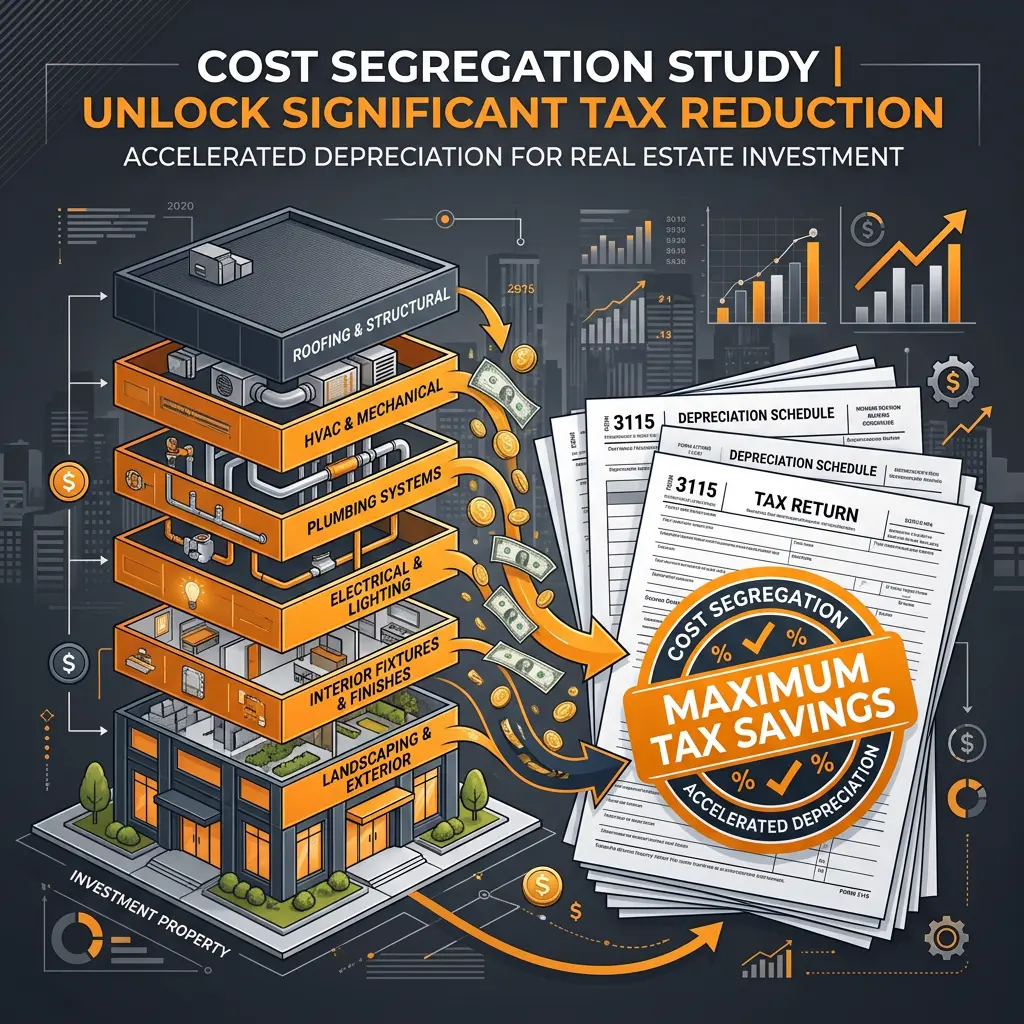
How a Cost Segregation Study Actually Works
Let's break down the basic mechanics of how a cost segregation study actually works. When you buy a residential rental or commercial building, tax laws assume the entire structure depreciates at a uniform rate. For residential property, that rate is 27.5 years. For commercial assets, it is 39 years. However, a building is not just a single block of wood and concrete. It is composed of numerous distinct subsystems, many of which wear out far faster than the building's main framework.
When you purchase an investment property, you are buying land and the physical building. A cost segregation study breaks these assets down into smaller, individual components. It segregates structural components (like walls, roofs, and foundations) from personal property and land improvements. Land itself cannot be depreciated, but almost everything else on the parcel can be classified under accelerated timelines.
For instance, a cost segregation study will isolate personal property like carpeting, appliances, specialty lighting, and security systems. It also identifies land improvements such as fences, sidewalks, driveways, and landscaping. By classifying these assets correctly, you can claim massive deductions in the first few years of property ownership, rather than waiting decades.
By conducting a cost segregation study, you can reclassify these items from a 39-year life to a 5, 7, or 15-year life. Under current tax laws, this reclassification unlocks the power of bonus depreciation. This means you can write off up to 100% (or the current phased-down percentage) of the value of those reclassified assets in the very first year you place the property in service. The cash flow benefits are massive.
Who Should Perform a Cost Segregation Study?
Who should perform a cost segregation study on their rental properties? While the tax savings are incredibly enticing, the process is not free. It requires hiring a specialized engineering firm to perform a forensic physical and financial audit of the building. Therefore, you must weigh the upfront costs against the projected tax savings.
If you own commercial buildings or residential apartments, executing a cost segregation study is almost always a wise financial move. The larger the asset, the more components there are to segregate. If you buy a retail strip center, a warehouse, or a 50-unit apartment building, the sheer volume of specialty wiring, parking lot asphalt, and commercial fixtures guarantees huge first-year write-offs.
Lenders and CPAs recommend a cost segregation study for properties valued over $500,000 to justify the upfront engineering costs. The study itself typically costs between $5,000 and $15,000 depending on the building's size and complexity. If your property is valued at $200,000, the tax savings might not cover the cost of the report. But for higher-value assets, the ROI is massive, often resulting in six-figure tax write-offs.
The Process: What to Expect During the Audit
A professional cost segregation study requires hiring a certified engineering firm to perform an on-site inspection. You cannot just guess the value of your property's carpets and light switches. The IRS has strict guidelines, and a sloppy, unscientific report will immediately trigger audits. You want a certified professional to handle the forensic calculations.
During the audit, the engineers preparing the cost segregation study will measure and inventory every depreciable asset. They will review construction blueprints, contractor invoices, and purchase contracts. They will determine the exact cost of the property's subcomponents, allocating value based on industry-standard cost estimation guides.
Once completed, you will submit the cost segregation study results to your CPA to file IRS Form 3115. This form handles the Change in Accounting Method, which is the official IRS procedure for reclassifying property depreciation. For a deeper look at the IRS guidelines regarding depreciation reclassification, the official IRS Publication 946 on Depreciating Property provides all the technical rules and schedules.
This IRS form allows you to claim the cost segregation study benefits without amending previous tax returns. This is a huge loophole known as "look-back segregation." If you bought a commercial building three years ago and claimed standard 39-year depreciation, you can perform a study today and claim all the missed accelerated depreciation as a lump-sum write-off on this year's tax return. It is an instant cash flow injection.
Real-World Example of Tax Mitigation
Let's look at a quick real-world example to illustrate the math. Suppose you purchase a multi-family property for $1,500,000 (excluding land value). Under standard straight-line depreciation, you would write off roughly $54,545 per year for 27.5 years. If you are in a 37% tax bracket, this results in an annual tax savings of about $20,180.
But say you perform a study. The engineers reclassify 25% of the property's value ($375,000) as 5-year and 15-year personal property. Using bonus depreciation, you write off that entire $375,000 in year one, alongside the remaining straight-line depreciation. This generates a massive first-year write-off that completely wipes out your rental income tax bill, and can even offset other active business income if you qualify as a Real Estate Professional under IRS rules. For more case studies, Investopedia's overview of cost segregation outlines historical tax savings statistics.
Frequently Asked Questions
Q: What is the main benefit of a cost segregation study?
A: The primary benefit is the acceleration of depreciation deductions, which significantly increases your near-term cash flow. By writing off assets in 5, 7, or 15 years instead of 27.5 or 39 years, you defer income taxes, keeping more cash in your business to acquire more properties or pay down debt.
Q: Can I perform a cost segregation study myself to save money?
A: No. The IRS Audit Techniques Guide explicitly states that a cost segregation study must be prepared by individuals with professional engineering and construction cost expertise. Self-prepared studies or simple estimator spreadsheets do not meet IRS standards and will be disallowed during an audit.
Q: What is depreciation recapture, and how does it impact my study?
A: Depreciation recapture is a tax the IRS charges when you sell a property for a profit after claiming depreciation. The IRS taxes the accumulated depreciation at a rate of up to 25%. If you plan to sell the property in a year or two, a study might not make sense because the recapture tax will wipe out your short-term savings. Studies are best for long-term hold strategies.
Q: What is a look-back cost segregation study?
A: A look-back study is performed on properties acquired in previous tax years. If you didn't accelerate depreciation when you bought the property, you can perform a study today and claim the cumulative catch-up depreciation on your current tax return using IRS Form 3115, without needing to file amended returns.
Q: Does a cost segregation study increase my risk of an IRS audit?
A: If prepared by a reputable, certified engineering firm that adheres to the IRS Cost Segregation Audit Techniques Guide, the study actually protects you. The IRS accepts well-documented studies. However, using uncertified calculators or aggressive, non-standard allocations will flag your return for review.
Conclusion
Ultimately, a cost segregation study is one of the most powerful tax reduction strategies available to property owners. By working with a qualified engineering firm and your CPA, you can legally defer thousands of dollars in taxes, boosting your immediate cash reserves to fund your next acquisition. If you own high-value properties and are tired of writing large tax checks to the government, speak with a tax professional today to see if a cost segregation study is the right move for your business.